
Canada’s International Student and Worker Arrivals Decline in 2026

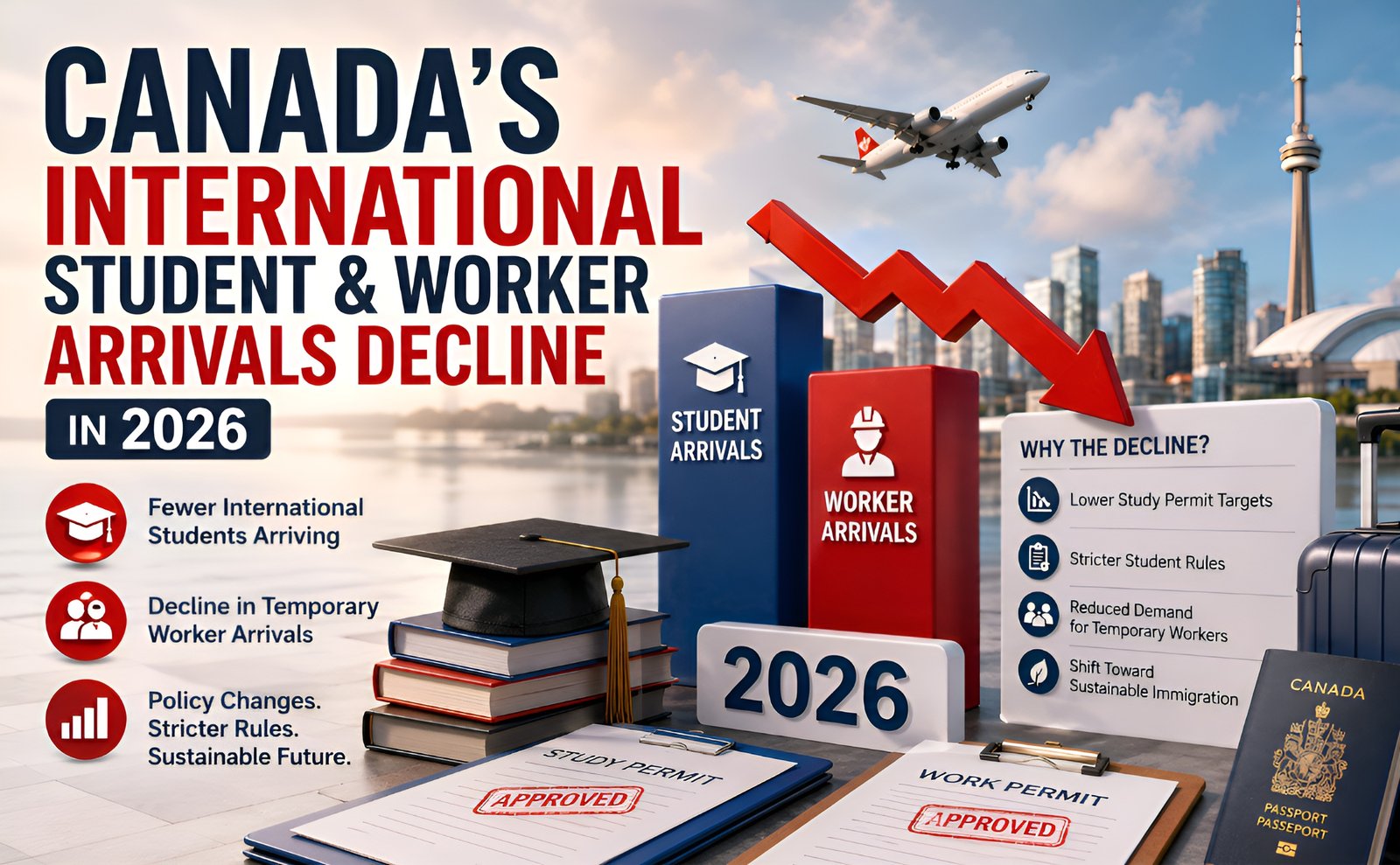
Canada Sees Sharp Decline in International Student and Temporary Worker Arrivals in 2026: What It Means for Future Applicants
Disclaimer: This article is for informational purposes only and does not constitute legal or immigration advice. Immigration rules, program criteria, and processing practices can change without advance notice. Applicants should always verify the latest requirements directly with Immigration, Refugees and Citizenship Canada (IRCC) or consult a licensed Canadian immigration professional before making immigration decisions.
Canada’s Temporary Immigration Landscape Is Changing
For many years, Canada has been recognized as one of the world’s top destinations for international students and skilled foreign workers. Its globally respected education system, strong economy, multicultural society, and numerous permanent residence pathways have attracted hundreds of thousands of newcomers every year.
However, 2026 is telling a different story.
Recent Immigration, Refugees and Citizenship Canada (IRCC) data indicates that both international student arrivals and temporary foreign worker admissions have declined significantly compared to previous years.
These changes are not necessarily a sign that Canada is closing its doors to newcomers. Instead, they reflect a deliberate shift in immigration policy aimed at balancing population growth, housing availability, infrastructure, and labour market demands.
For prospective students, workers, employers, and families planning to immigrate, understanding these trends is essential for making informed decisions and preparing stronger applications.
International Student Arrivals Continue to Decline in 2026
Canada welcomed approximately 3,335 new international students in May 2026.
Although student arrivals naturally fluctuate throughout the year because of academic intake periods, the latest figures show a noticeable decline compared to previous years.
Compared with April 2026, student arrivals dropped by approximately 32%.
Year-over-year, arrivals were also significantly lower than the same month in 2025.
While seasonal fluctuations are expected, the broader trend reflects Canada’s current strategy to gradually reduce the overall number of temporary residents living in the country.
International Student Snapshot – May 2026
➧Approximately 3,335 new international students arrived in Canada.
➧More than 632,000 study permit holders were residing in Canada at the end of May 2026.
➧Student arrivals were approximately 26% lower than during May 2025.
These numbers demonstrate that Canada continues welcoming international students while applying tighter controls over overall intake volumes.
Student Arrivals Have Fallen Significantly Since 2024
The decline becomes even more noticeable when looking at the first five months of the year.
Between January and May 2026:
➧Approximately 19,425 new international students arrived in Canada.
Compared to previous years:
➧Student arrivals were about 83% lower than the same period in 2024.
➧They were nearly 40% lower than the first five months of 2025.
Although these figures appear dramatic, they should be viewed within the context of Canada’s broader immigration strategy rather than as a decline in educational quality or international demand.
Canada remains one of the world’s leading destinations for international education.
Monthly International Student Arrivals in 2026
| Month | New Student Arrivals |
|---|---|
| January | 7,040 |
| February | 2,135 |
| March | 2,085 |
| April | 4,940 |
| May | 3,335 |
Historically, student arrivals increase substantially during August and September as colleges and universities prepare for the fall semester.
Smaller increases are also common before winter and spring academic intakes.
Will Canada Reach Its International Student Target in 2026?
The federal government established a target of approximately 155,000 new international student arrivals for 2026.
By the end of May, Canada had admitted only about 13% of that target.
Does this mean the target cannot be achieved?
Not necessarily.
The busiest student arrival period is still ahead.
Most international students begin their programs during:
➧Fall semester (August–September).
➧Winter semester (December–January).
These seasonal intake periods historically account for the largest share of annual student arrivals.
However, given the current pace of admissions and recent policy changes, reaching the annual target may prove challenging.
Why Student Numbers Are Declining
Several policy changes have contributed to lower international student admissions.
Canada has introduced measures designed to better manage temporary resident growth while addressing concerns such as:
➧Housing availability.
➧Public infrastructure.
➧Healthcare capacity.
➧Labour market balance.
➧Student support services.
At the same time, immigration authorities have increased scrutiny of study permit applications to ensure applicants genuinely meet eligibility requirements.
As a result, prospective students should expect a more competitive application process than in previous years.
Temporary Foreign Worker Arrivals Also Declined
International students are not the only group affected by Canada’s evolving immigration strategy.
Temporary foreign worker admissions have also decreased.
In May 2026, Canada welcomed approximately 19,645 temporary workers.
This represented:
➧Around 10% fewer arrivals than April 2026.
➧Approximately 16–17% fewer than May 2025.
➧Nearly 43% fewer than May 2024.
Although employers across Canada continue facing labour shortages in several industries, immigration authorities are carefully managing the number of new temporary workers entering the country.
Worker Arrival Snapshot – May 2026
Key highlights include:
➧Approximately 19,645 new temporary workers arrived.
➧More than 1.56 million individuals held work permits in Canada.
➧Overall work permit holders continued increasing despite fewer new arrivals.
This reflects the fact that many foreign workers already in Canada continue extending permits, changing immigration status, or transitioning toward permanent residence.
Temporary Foreign Worker Program vs. International Mobility Program
Canada’s work permit system includes multiple pathways.
Temporary Foreign Worker Program (TFWP)
Approximately 4,610 workers entered Canada through the Temporary Foreign Worker Program during May 2026.
This represented another decline compared to both April 2026 and May 2025.
The TFWP generally requires employers to obtain a Labour Market Impact Assessment (LMIA) before hiring foreign workers.
International Mobility Program (IMP)
The International Mobility Program remained the larger pathway.
Approximately 15,035 workers entered Canada under IMP categories during May.
These include work permits issued through programs such as:
➧Post-Graduation Work Permits (PGWPs).
➧International Experience Canada (IEC).
➧Spousal Open Work Permits.
➧Other LMIA-exempt categories.
Although IMP admissions also declined slightly, they remained considerably higher than TFWP admissions.
Monthly Temporary Worker Arrivals in 2026
| Month | New Worker Arrivals |
|---|---|
| January | 11,850 |
| February | 10,375 |
| March | 13,910 |
| April | 21,900 |
| May | 19,645 |
Worker arrivals traditionally increase during summer as seasonal industries expand recruitment.
Whether that trend continues throughout the remainder of 2026 remains to be seen.
Can Canada Still Meet Its Worker Arrival Target?
Under the 2026 Immigration Levels Plan, Canada aims to welcome approximately 230,000 temporary workers during the year.
By the end of May:
➧Approximately 77,915 workers had arrived.
That represents roughly one-third of the annual objective.
Although additional hiring activity typically occurs during the summer months, current trends suggest the government will continue carefully balancing labour market needs with broader immigration objectives.
Canada’s Temporary Resident Population Continues Growing
Interestingly, while fewer new temporary residents are arriving, the overall number of people already living in Canada with valid permits continues increasing.
As of May 31, 2026:
| Permit Type | April 2026 | May 2026 |
|---|---|---|
| Study Permit Holders | 631,445 | 632,850 |
| Work Permit Holders | 1,552,950 | 1,561,465 |
This may seem contradictory at first.
However, it reflects the fact that many individuals admitted under previous immigration policies continue holding valid permits, extending their status, or progressing toward permanent residence.
Policy changes often take months—or even years—to be fully reflected in overall population figures.
More Temporary Residents Are Becoming Permanent Residents
One of the most significant trends emerging in 2026 is the growing number of temporary residents successfully transitioning to permanent residence.
Between January and May 2026:
Approximately 84,135 former temporary residents became permanent residents.
This accounted for more than half of all permanent resident admissions during that period.
Compared with previous years, this represents a growing emphasis on selecting individuals who already have Canadian education, work experience, or community ties.
Several immigration pathways continue supporting these transitions, including:
- Express Entry.
- Provincial Nominee Programs (PNPs).
- Canadian Experience Class (where applicable).
- Employer-supported immigration pathways.
- Provincial economic immigration streams.
The federal government’s In-Canada Workers Initiative is also contributing to this trend by helping eligible workers already living in Canada transition more quickly to permanent residence.
What These Immigration Trends Mean for Future Applicants
Although Canada has reduced the pace of new temporary resident arrivals, opportunities continue to exist for qualified applicants.
Success, however, increasingly depends on preparation.
Prospective students should focus on:
➧Choosing recognized educational institutions.
➧Demonstrating genuine study intentions.
➧Preparing complete and accurate documentation.
➧Showing sufficient financial capacity.
Temporary workers should focus on:
➧Securing legitimate employment opportunities.
➧Understanding employer requirements.
➧Exploring provincial nomination opportunities.
➧Planning for long-term immigration pathways.
Applicants already living in Canada may benefit from the government’s continued emphasis on transitioning experienced temporary residents into permanent residents.
Final Thoughts: Quality Over Quantity in Canada’s Immigration Strategy
Canada’s immigration system is evolving.
Rather than simply increasing admission numbers, immigration authorities are placing greater emphasis on sustainable population growth, labour market priorities, housing capacity, and successful newcomer integration.
While the number of new international students and temporary workers has declined compared with previous years, Canada remains committed to welcoming individuals who can contribute to its economy, communities, and future growth.
For applicants, the message is clear:
A well-prepared application supported by accurate documentation, strong eligibility, and a clear immigration strategy is more important than ever.
At ImmigrantResource.ca, we are committed to helping newcomers understand Canada’s changing immigration landscape through trusted resources, practical guidance, and up-to-date educational content that empowers you to make informed immigration decisions.

I have been playing online for years and trust takes time to build. After testing the loyalty program and game variety here, I am genuinely impressed. Everything runs smoothly on my phone and I never felt rushed by the interface. It is rare to find a site that actually cares about player comfort. vnnh885